
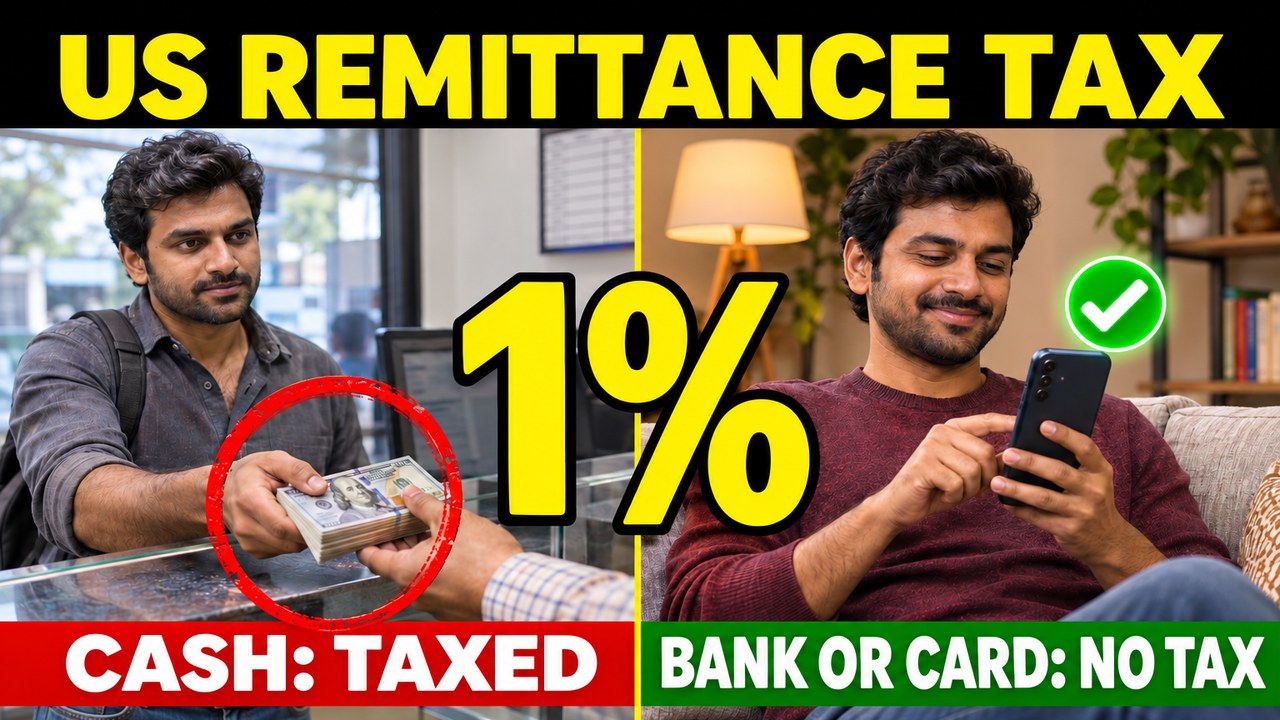
The US remittance tax is a 1% federal excise tax on money sent abroad, and it has applied to transfers made after 31 December 2025. But it only applies when you pay the transfer provider in cash, by money order, by cashier’s check or with a similar physical instrument. If the money comes out of a US bank account or is paid with a US debit or credit card, there is no tax.
For most Indians in the US who send money home through a bank or an app linked to their bank account, nothing changes. The people most affected are those who send cash over the counter at a money transfer shop. On a USD 1,000 cash transfer to India, the tax is USD 10.
Table of Contents
At a glance
| Item | Details |
|---|---|
| Law | Section 4475 of the US Internal Revenue Code |
| Rate | 1% of the amount transferred |
| Applies to | Remittance transfers made after 31 December 2025 |
| Taxed payment methods | Cash, money order, cashier’s check or a similar physical instrument |
| Not taxed | Money withdrawn from an account at a US financial institution; transfers funded with a US-issued debit or credit card |
| Who pays | The sender |
| Who collects | The remittance transfer provider, which reports and pays it to the IRS |
| Status of IRS rules | Proposed regulations published in April 2026 |
How the US remittance tax works

The tax was created by the 2025 US budget law and sits in section 4475 of the Internal Revenue Code. The IRS summary in Internal Revenue Bulletin 2026-18 says the section “imposes a one percent tax on remittance transfers made after December 31, 2025, for which the sender provides cash, a money order, a cashier’s check, or other similar physical instrument to the remittance transfer provider.”
The tax is charged to you as the sender, but you do not file anything with the IRS yourself. The provider collects the 1% at the time of the transfer and pays it over to the IRS. Earlier drafts of the bill proposed much higher rates and focused on non-citizens. The final law uses a flat 1% and depends on how you pay, not on your citizenship or visa status.
Which transfers are taxed and which are not
| How you send money to India | 1% tax? |
|---|---|
| Cash handed over at a money transfer counter | Yes |
| Money order or cashier’s check given to the provider | Yes |
| Bank wire from your US bank account | No |
| Transfer app funded from your linked US bank account | No |
| Transfer paid with a US-issued debit or credit card | No (your card issuer may charge its own fees) |
Example: what 1% means in practice
| Amount sent in cash | US remittance tax at 1% |
|---|---|
| USD 500 | USD 5 |
| USD 1,000 | USD 10 |
| USD 2,500 | USD 25 |
| USD 5,000 | USD 50 |
The same amounts sent from a US bank account or with a US-issued card would carry no remittance tax. The provider’s own fees and exchange rate margin still apply either way, and they often cost more than 1%, so compare the total cost before you send.
Where the IRS rules stand
The IRS published proposed regulations on the tax in the Federal Register on 13 April 2026 (REG-114499-25). They explain how providers should calculate, collect and report the tax. Providers report it on IRS Form 720, the quarterly federal excise tax return. Until final regulations are issued, details such as how particular card types are treated could still be adjusted, but the 1% rate and the cash-based scope come from the law itself.
How to avoid paying the US remittance tax legally
- Send from your US bank account. A bank wire or a transfer app funded directly from your bank account is not taxed.
- Use a US-issued debit or credit card if your provider accepts it, but check card fees and whether a credit card treats it as a cash advance.
- Deposit cash into your bank first. If you are paid in cash, depositing it and sending from your account avoids the 1% tax on the transfer.
- Compare the full cost. Look at the exchange rate and fees, not only the tax.
- Keep your receipts. Your provider’s receipt shows any remittance tax charged.
Common questions from NRIs
| Question | Short answer |
|---|---|
| I am a green card holder. Does the tax apply to me? | Only if you pay in cash or with a similar physical instrument. Citizenship and visa status do not matter. |
| Does my family in India pay anything? | No. This US tax is collected from the sender at the US end. |
| Is this the same as India’s TCS on money sent abroad? | No. TCS is an Indian rule on money leaving India. The US remittance tax is on money leaving the US. |
| Do I report it on my US tax return? | No. The provider collects and reports it. |
Important links
| Resource | Link |
|---|---|
| IRS Internal Revenue Bulletin 2026-18 | IRB 2026-18 (proposed remittance tax rules) |
| Proposed regulations (Federal Register) | Excise Tax on Remittance Transfers |
| Form 720 (for providers) | About Form 720 |
Related guide: Renewed your passport recently? If you hold an OCI card, read our guide to the OCI new passport update and the e-OCI card.
FAQ
What is the US remittance tax rate?
It is 1% of the amount transferred, on transfers made after 31 December 2025.
Is money sent from my bank account to India taxed?
No. Transfers funded from an account at a US financial institution are not subject to the tax.
Are card-funded transfers exempt?
Transfers funded with a debit or credit card issued in the United States are not taxed under the law.
Who collects the tax?
The remittance transfer provider collects it from the sender and reports it to the IRS each quarter on Form 720.
Does the tax depend on my visa or citizenship?
No. It depends on how you pay for the transfer, not on who you are.
Source: Internal Revenue Code section 4475 as summarised in IRS Internal Revenue Bulletin 2026-18, and the proposed regulations published in the Federal Register on 13 April 2026. Last checked: 28 November 2026. This article is general information, not tax advice. Speak to a qualified tax professional about your own situation. We will update it when the IRS issues final regulations.