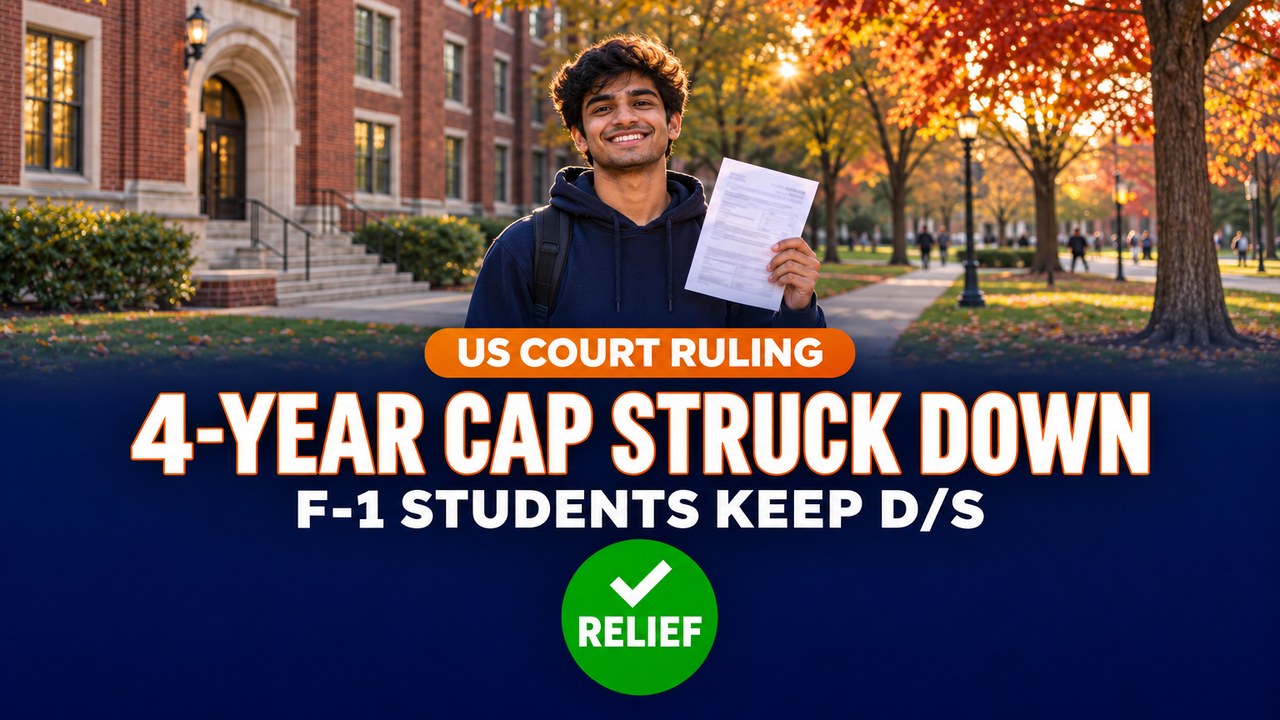
The F-1 duration of status rule that would have capped most international students at four years in the United States will not take effect. On 16 November 2026, a federal judge in Massachusetts vacated the entire Department of Homeland Security (DHS) rule, so F-1 students, including the large number of Indian students on US campuses, stay on the familiar “duration of status” system.
In practical terms, nothing changes for you today: your I-94 still shows D/S, your grace period after finishing your program is still 60 days, and you extend your stay through your school’s Designated School Official (DSO), not through a separate USCIS application. DHS can still appeal, so it is worth knowing exactly what was struck down and what to watch next.
Table of Contents
At a glance
| Item | Details |
|---|---|
| Status | Court order: rule vacated in full (not just paused) |
| Court | US District Court for the District of Massachusetts, Judge F. Dennis Saylor IV |
| Date of ruling | 16 November 2026 |
| Rule affected | DHS final rule published on 17 July 2026, planned to start on 15 September 2026 |
| Who it covers | F-1 students, J-1 exchange visitors and I visa media workers |
| What applies now | The existing duration of status (D/S) framework |
| Next step to watch | A possible DHS appeal to the First Circuit |
What the F-1 duration of status rule would have changed
For decades, F-1 students have been admitted for “duration of status”. That means you may stay as long as you are enrolled full time and making normal progress, plus a short grace period, instead of being given a fixed end date. The July 2026 rule would have replaced this with a fixed admission period. The main changes it planned were:
- A fixed end date tied to the program dates on your Form I-20, capped at four years.
- Extensions through USCIS: staying longer would have needed an extension of stay application to USCIS, with no appeal if it was refused.
- A shorter grace period: the time to leave, transfer or change status after completing a program would have dropped from 60 days to 30 days.
- Limits on changing course: restrictions on transfers, changes of program and a second degree at the same level, and a cap on English language training.
For Indian students on PhD tracks, dual degrees or longer engineering programs, a four-year cap with a discretionary extension would have added cost and uncertainty to every year of study.
What the court decided
The case, Presidents’ Alliance on Higher Education and Immigration v. Department of Homeland Security (No. 1:26-cv-13799), was brought by a coalition of higher education groups and unions. The court had already postponed the rule on 14 September 2026, one day before it was due to start, so it never took effect.
In its 16 November order, the court granted summary judgment to the challengers. It held that the rule was arbitrary and capricious under the Administrative Procedure Act and that parts of it went beyond what the law allows DHS to do with the F-1 program. DHS had asked the judge to send the rule back for changes while leaving it in place. The court refused and vacated the whole rule instead.
You can read the court’s summary judgment order (PDF), published by NAFSA, one of the groups behind the case, along with NAFSA’s explanation of the ruling.
What applies to F-1 students now
| Topic | Under the vacated rule | What applies now |
|---|---|---|
| Length of stay | Fixed end date, maximum four years | Duration of status (D/S) while you maintain status |
| Getting more time | USCIS extension of stay application | Your DSO extends the program end date on your I-20 |
| Grace period after completing studies | 30 days | 60 days |
| OPT and STEM OPT | Admission tied to your EAD dates | Existing OPT and STEM OPT rules continue |
| Transfers and program changes | Restricted | Allowed under existing SEVP rules |
What to do now
- Check your I-20 end date. If you need more time to finish, ask your DSO for a program extension before that date. The SEVP guide to students and the Form I-20 explains what the form controls.
- Ignore older advice about filing with USCIS for more time. That step belonged to the vacated rule.
- Keep your status clean. Full-time enrollment, valid SEVIS records and authorised work only. D/S protects you only while you maintain status.
- Plan OPT as usual. OPT and STEM OPT continue under the existing rules.
- Watch for an appeal. If DHS appeals and asks for a stay, the position could change again. We will update this article if it does.
Could this change again?
Yes, it could. Employer and higher education groups expect DHS to appeal the final judgment to the First Circuit Court of Appeals. An appeal on its own does not bring the rule back. For that, DHS would need a stay of the ruling or a win on appeal, or it would have to write a new rule through a fresh notice and comment process. Separate DHS proposals on OPT and on work visa grace periods are also moving through the rulemaking process. Proposals are not law until a final rule is published with a start date.
Important links
| Resource | Link |
|---|---|
| Court order of 16 November 2026 (PDF) | Summary judgment order |
| NAFSA explainer | District court ruling preserves D/S |
| SEVP (Study in the States) | Students and the Form I-20 |
| News report | Bloomberg Law coverage of the ruling |
Related guide: Weighing your options beyond the US? Read our guides to the UK Graduate visa change to 18 months and the Australia student visa costs and evidence rules for Indian students.
FAQ
Is the F-1 duration of status rule in force?
No. The rule was postponed on 14 September 2026 and vacated on 16 November 2026, so it never took effect. Duration of status continues.
Do I need to file Form I-539 to stay longer in the US?
No. Under the current system, your DSO extends your program end date on your I-20. The USCIS extension step was part of the rule that the court struck down.
Is my grace period 30 days or 60 days?
For F-1 students it remains 60 days after you complete your program or OPT.
Does this ruling affect OPT or STEM OPT?
No. OPT and STEM OPT continue under the existing rules. Watch separate DHS proposals, which are not in force unless a final rule is published.
Can DHS bring the rule back?
Only through a successful appeal, a court-ordered stay or a new rulemaking. None of these had happened when this article was last checked.
Source: US District Court for the District of Massachusetts, summary judgment order of 16 November 2026 in Presidents’ Alliance on Higher Education and Immigration v. DHS (No. 1:26-cv-13799). Last checked: 28 November 2026. This article explains public information and is not legal or immigration advice. Speak to your DSO or a licensed immigration attorney about your own case. We will update this page if DHS appeals.